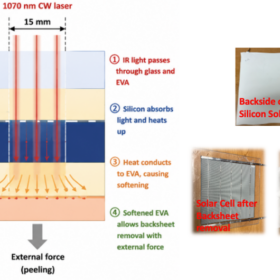
Continuous-wave infrared laser technology enables damage-free backsheet removal in end-of-life solar modules
U.S. researchers have developed an IR-CW laser-based method to remove backsheets from end-of-life silicon solar modules without damaging the glass or wafers, using controlled heating of the silicon–EVA interface through the front glass. The process enables clean mechanical delamination with preserved device performance and offers a lower-energy, lower-cost alternative to conventional thermal or chemical recycling methods.

Solar Impulse 2 crashes in Gulf of Mexico during unmanned test flight
The aircraft, acquired by Skydweller Aero in 2019 and converted into an autonomous long-endurance platform, crashed after a loss of power. It was equipped with approximately 17,000 photovoltaic cells on its wings.
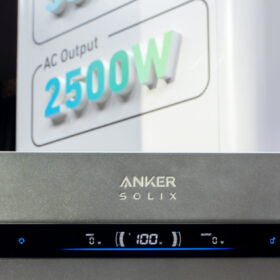
Anker Solix launches modular 5 kWh battery for residential PV
The Chinese manufacturer has unveiled its new Solarbank 4 E5000 Pro in Berlin. The system features 5 kW of photovoltaic input capacity and 5 kWh of storage capacity.
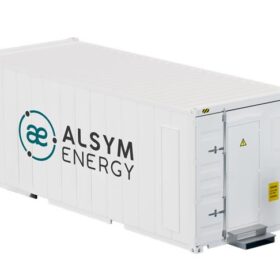
Alsym and Juniper to deploy 500 MWh of sodium-ion battery storage
Strategic agreement will see California-based renewables developer ramp up sodium-ion battery deployment. Deal follows Alsym Energy entering 8.5 GWh partnership with iron flow battery business ESS.
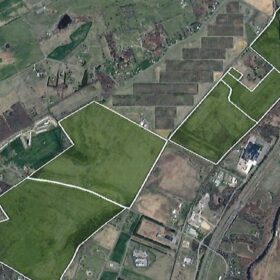
U.S. Solar developer seeks connection to wrong powerline, delays project five years
The OFW Solar Project in Virginia submitted an application to connect to powerlines run by the wrong power company, instead of a second set of nearby transmission lines, necessitating a total restart of the PJM interconnection process that could push construction back to 2032.

South Korea’s first agrivoltaics law leaves half of farmland off-limits
South Korea’s National Assembly has passed the country’s first dedicated agrivoltaics legislation, enabling dual use of agricultural land for solar power generation, but the law excludes zones covering nearly half of the country’s farmland, according to a Seoul-based nonprofit group focused on energy transition.
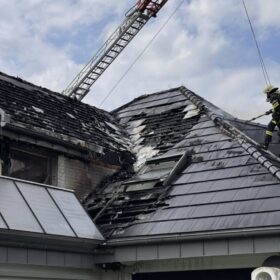
Fire hits German home fitted with photovoltaic tiles
The fire spread beneath the roof structure and required extensive manual dismantling of PV-integrated components before being fully extinguished. A firefighter was injured by electric shock during the blaze.
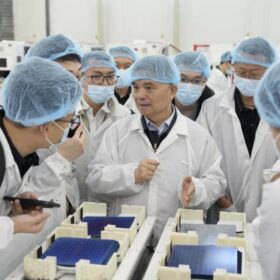
Jolywood starts mass production of low-silver TOPCon solar cells
The Chinese manufacturer said its novel TOPCon cell design enables partial replacement of silver with aluminum paste while maintaining TOPCon-level efficiency of over 27% and compatibility with existing production lines.
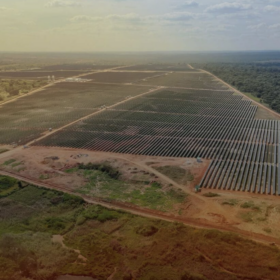
Zambia’s largest solar plant goes online
The 136 MW Itimpi II solar plant is Zambia’s largest operational solar project to date. Elsewhere in the country, an investment agreement has been signed to add 250 MW of solar to the 100 MW Nambala solar power plant.
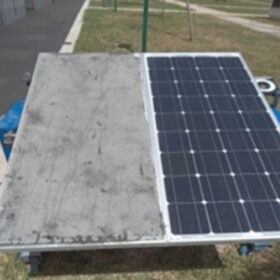
The impact of fly ash-induced soiling on PV panel performance
Scientists in Morocco have conceived an experimental–numerical model to quantify how fly ash soiling affects photovoltaic (PV) modules, capturing both optical losses and thermal effects. Their findings show that while dust layers can reduce panel temperature, fly ash significantly degrades efficiency in a non-linear way, highlighting the need for predictive models for real-world solar performance.
