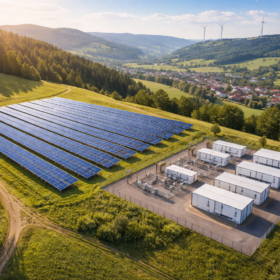
Why technical due diligence is becoming the backbone of Europe’s solar-storage boom
Europe’s hybrid solar-plus-storage projects are growing rapidly, but increasing complexity means treating technical due diligence as a formality is now a serious risk. Rigorous, lifecycle-based technical due diligence (TDD) – covering financial, supply chain, digital, and ESG factors – is essential to ensure project reliability, investor confidence, and a resilient clean-energy transition.

Key takeaways from Solar Solutions Amsterdam
The fourteenth edition of Solar Solutions Amsterdam showcased the latest technologies across solar, storage, electric vehicle charging and green HVAC. This year saw energy storage systems dominate the show floor, ahead of the event’s rebrand to Sustainable Solutions Amsterdam from next year onwards, reflecting the Dutch market’s position as a mature market increasingly focused on flexibility and the connectivity of different technologies within a single system.
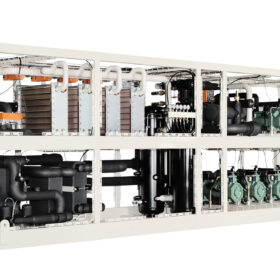
Advansor unveils scalable CO2 heat pump for large-scale heating needs
The Danish company said its configurable CO2 system delivers up to 4.8 MW per unit and is scalable to 50 MW for large industrial and commercial projects. The units offer hot water output of up to 95 C and compatibility with complex installations such as food processing, district heating, and commercial buildings.
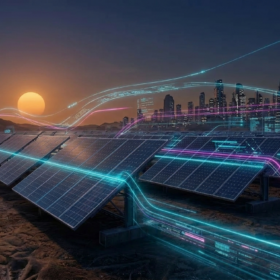
Solar and the cyber winter
In an interview with pv magazine, cybersecurity expert Roberto Setola describes a structural shift in cyber threats against solar energy infrastructure, where attacks now target peripheral systems like remote terminal units rather than centralized SCADA, often in coordinated campaigns amplified by AI. He also emphasized that the recent cyberattack to PV plants in Poland demonstrated how simultaneous strikes on smaller, less-protected operators can potentially trigger major disruptions, including blackouts, economic losses, and cascading grid risks.
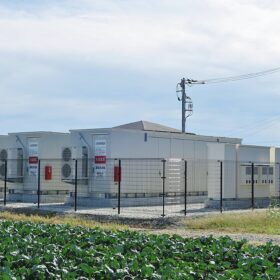
Panasonic claims world’s first trial of cybersecurity monitoring for grid-scale BESS
A Japanese joint-pilot will test grid-scale BESS with a range of local and remote attack vectors, with cybersecurity monitoring to watch for indications of anomalies.
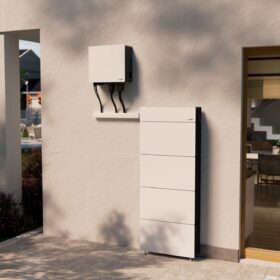
SolarEdge launches Nexis hybrid inverter and high-voltage battery for residential PV
The Nexis solution combines a flexibly configurable hybrid inverter with a modular high-voltage battery offering up to 14 kW charging capacity per stack. The inverter delivers 8–20 kW AC power, supports up to 200% DC oversizing, and features IP65-rated design with integrated backup power.
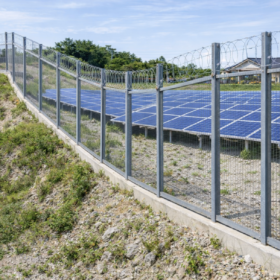
Japanese firm GBP launches fencing for solar and BESS sites
GBP K.K., a Japan-based clean energy infrastructure company, has launched perimeter fencing systems for grid-scale solar and battery energy storage system (BESS) sites, targeting security in difficult terrain and noise mitigation near residential areas.
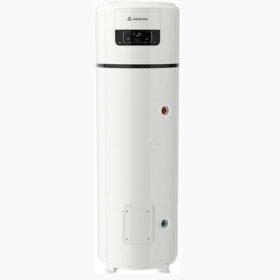
Ariston launches residential propane heat pump with built-in PV function
The Italian heating solutions provider said its new Nuos Plus S2 Wi-Fi heat pump system offers up to 80% energy savings and a coefficient of performance of up to 3.51.
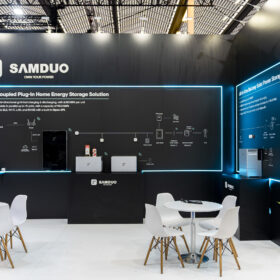
Samduo launches residential AC-coupled plug-in storage systems
The Chinese manufacturer said its new Nex E6000 and Nex E6000H storage systems combine a 6 kWh battery, an inverter, and an integrated energy management system, with scalable design allowing multiple units to be networked for higher capacity and coordinated energy sharing.
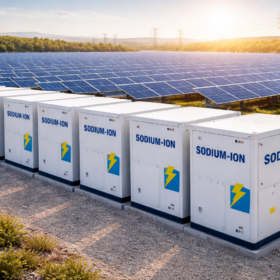
2D carbon selenide offers route to competitive sodium-ion batteries
Researchers at TU Delft propose using 2D carbon selenide as a sodium-ion battery anode, offering a theoretical capacity of 589 mAh/g with minimal volume expansion. Computational studies confirmed the material’s structural and thermal stability, as well as tunable electrochemical properties, making it a promising candidate for large-scale, renewable-linked energy storage.
