
Vienna’s largest stadium completes solar array
Vienna’s Ernst Happel Stadium has completed the installation of a solar array capable of generating 3.8 GWh of energy annually, with full operation expected by the end of the year.
Powering the AI revolution
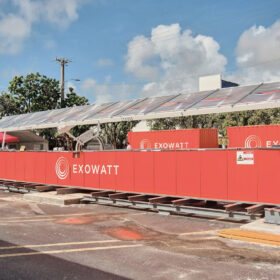
Developers from the renewable energy and data center markets are working to find common ground to meet surging energy demand fueled by the artificial intelligence boom.
Power electronics for customized battery energy storage
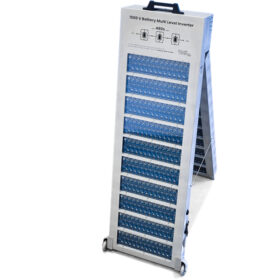
Startup p&e power&energy is offering multilevel inverter technology to manufacturers and integrators of battery energy storage systems (BESS). Interconnecting individual cells enables cost savings and the service life and efficiency of the systems, which can be individually configured for each application, can be increased.

Record year for UK solar as renewables generate most electricity
Renewables accounted for majority of annual UK electricity generation for the first time in 2024, with solar enjoying record highs despite fewer sun hours Gains for PV reflect increased deployed capacity, which hit 18 GW in February 2025 according to the latest government figures.
Borussia Dortmund plans 4.2 MW PV system at soccer stadium
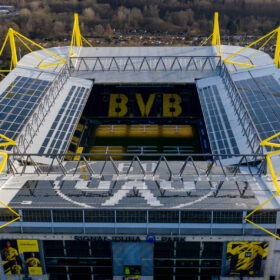
Borussia Dortmund, a German soccer team, is partnering with JA Solar and RWE to install a 4.2 MW solar system with battery storage at its stadium, supplying 4 MWh for on-site consumption. A smaller PV installation is already in operation on the stadium roof.
Sulzer, Hyme Energy to commercialize novel molten salt energy storage
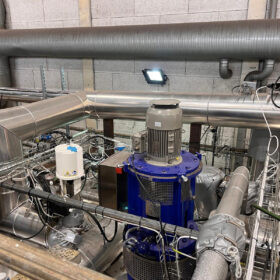
Sulzer is developing advanced pumps for Hyme Energy’s patented molten hydroxide salt energy storage technology. Building on the success of the pioneering Molten Salts Storage (MOSS) project in Denmark, the partners now seek to commercilize the solution.

Edilians launches tile-like mounting system for rooftop solar
Edilians introduced Easy Roof Integration, its new mounting system for residential PV panels, at the BePositive trade show this week in Lyon, France.

Austria installs 2.2 GW of PV in 2024
Austria installed 2.2 GW of new PV capacity in 2024, bringing its cumulative total to 8.3 GW by the end of the year, according to industry group PV Austria.

Heat pump control strategy for energy communities
Researchers have utilized measured data from a small energy community on a Finnish university campus to simulate its operation under various control strategies. The first control strategy prioritizes the use of heat pumps, while the second prioritizes price. Total costs were reduced by up to 25% with the second option.

France’s Imeon launches AI-powered home solar-plus-storage system
Neo learns and adapts to user consumption habits, ensuring optimal use of rooftop solar energy and improving battery life.
