The Hydrogen Stream: Netherlands commissions 32-km hydrogen pipeline

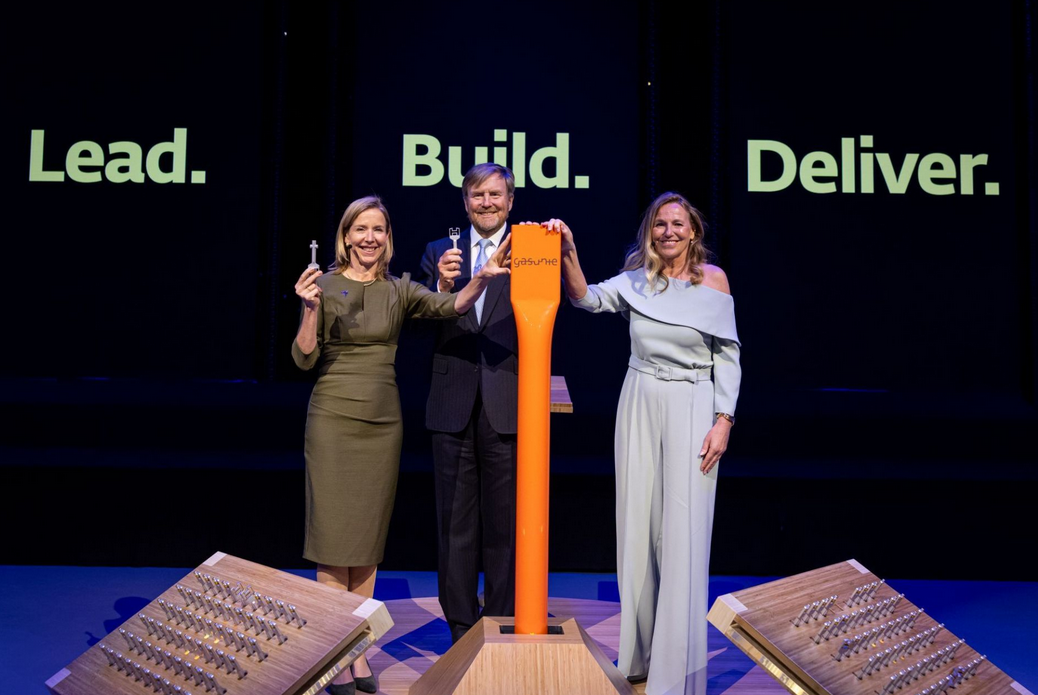
Dutch gas infrastructure operator Gasunie has inaugurated the first major section of its hydrogen backbone in the Port of Rotterdam: a 32-km pipeline that strengthens the region’s emerging hydrogen network. The pipeline runs entirely within the industrial port area in the province of South Holland, connecting the Maasvlakte area, specifically the Maasvlakte 2 expansion on the North Sea coast, with Pernis, an important petrochemical and refining hub further inland along the Nieuwe Maas river. The new pipeline links two key energy zones within the port. At Maasvlakte, large-scale developments in green hydrogen production are taking shape, including projects powered by offshore wind energy. At Pernis and the surrounding Energy and Chemicals Park Rotterdam, hydrogen is already widely used in refining and chemical processes. By connecting these areas, the pipeline enables the transport of low-carbon hydrogen from future production sites directly to existing industrial users, supporting the replacement of conventional fossil-based hydrogen. “Construction of the national hydrogen network began in October 2023. With the completion of this first section, hydrogen can now be transported from production locations at Maasvlakte to industrial users,” said Gasunie, adding that, over the coming years, the network will be expanded further to connect the major industrial regions in the Netherlands, as well as storage facilities and networks in Germany and Belgium. Meawnhile, Gasunie and the German transmission system operators Open Grid Europe and Thyssengas signed an agreement to jointly develop a cross‑border hydrogen connection between the Netherlands and Germany. “The companies are aiming to realise the connection between Zevenaar and Elten around 2031,” said the Dutch company.
University of Lausanne and Germany’s GFZ Helmholtz Centre for Geosciences have shown that erosion plays a key but complex role in the formation and accumulation of so-called “natural” hydrogen. Their findings suggest that the Western Pyrenees, and to a lesser extent the central Italian Alps, could be promising targets for natural hydrogen exploration. Using numerical plate tectonic models, the researchers demonstrated that “erosion can promote the uplift of mantle rocks toward the surface, which improves the conditions for serpentinization and therefore increases the potential for natural hydrogen generation.” Serpentinization is a geological process in which water reacts with iron- and magnesium-rich mantle rocks such as peridotite, producing hydrogen in the process. However, the study also highlights a limiting factor. “Erosion that is too rapid or too intense can reduce this potential, either by destroying reservoir rocks or by altering the temperature conditions required for hydrogen formation,” the researchers explained in a paper published in JGR Solid Earth.
Colombia’s Mining and Energy Planning Unit (UPME) has launched the Single User System (SUU), enabling individuals, companies, and developers to apply for tax incentive certificates for hydrogen-related projects. The mechanism covers white hydrogen exploration, as well as green and blue hydrogen activities, including production, transportation, distribution, storage, compression, conditioning, and end-use applications.
India’s Advait Energy Transitions has signed a Memorandum of Understanding with Norway’s Teco Fuel Cell Technology at the 3rd India–Nordic Summit in Oslo. According to a joint press release, “the MoU establishes a framework for hydrogen fuel cell manufacturing in India. Under the collaboration, Teco Fuel Cell Technology AS and co-development partner AVL List GmbH of Austria will bring their jointly developed 400 kW hydrogen fuel cell module, along with a 100 kW hydrogen fuel cell stack, to India for local manufacture, adaptation, and deployment.” The collaboration targets production for stationary power applications, including data centres, from Q1 2027, with production for heavy-duty transport, mobility, maritime, and shipping applications expected to begin in 2028.
Ohmium and RenewCO₂ have announced a collaboration to bring electrochemical CO₂ conversion technology to commercial scale. Ohmium, a US-based manufacturer of modular proton exchange membrane (PEM) electrolyzers, will work with RenewCO₂, which has developed processes for converting CO₂ into valuable chemicals and fuels. “We envision Ohmium’s manufacturing expertise and electrolyzer platform enabling us to scale rapidly. Together, we’re transforming CO₂ from liability to resource and accelerating this industrial shift,” said Anders Laursen, CEO of RenewCO₂.
Uniper Hydrogen has launched an Open Season process for capacity at its planned Hydrogen Import Terminal in Wilhelmshaven, Germany. The Open Season consists of two consecutive phases. In the first phase, which concludes on June 15, market participants are invited to submit an expression of interest indicating their desired capacity. In the subsequent allocation process, capacity reservations will be confirmed. In the second phase, Heads of Terms will be issued as the basis for a Terminal Use Agreement, which will be developed with participating shippers. The process concludes with the signing of the Terminal Use Agreement, resulting in a binding capacity booking, the company said.
H2 Mobility will deploy six hydrogen trailers to supply its refuelling stations in the future. Following a test phase lasting several weeks, the first two trailers have now entered regular service, the company said in an emailed statement.
The European Commission has approved a €1.3 billion ($1.51 billion) German state aid scheme to support the production of renewable hydrogen under the European Hydrogen Bank’s “Auctions-as-a-Service” mechanism for the 2026 auction round. The aid will be awarded through a competitive bidding process supervised by the European Climate, Infrastructure and Environment Executive Agency (CINEA), the Commission said.
The Swedish Energy Agency’s Industriklivet initiative has awarded €21 million to SkyKraft, a joint venture between SkyNRG and Skellefteå Kraft. The funding will support the next phase of Project SkyKraft’s feasibility work, including design and engineering activities required to prepare for a final investment decision (FID) in 2027. Once operational, SkyKraft aims to produce up to 130,000 tonnes of eSAF annually using renewable electricity and biogenic CO₂.
This content is protected by copyright and may not be reused. If you want to cooperate with us and would like to reuse some of our content, please contact: [email protected].

Please login to comment