Top News
South Korea widens tax credits for low-carbon solar manufacturing

OCI in talks with SpaceX for polysilicon supply
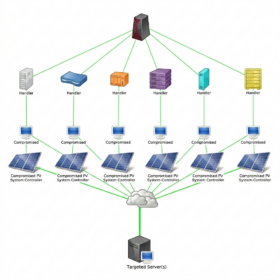
Cyber threats for PV: What are distributed denial-of-service attacks and how do they work
Out now - pv magazine Global April Issue
The new pv magazine Global issue is out now!
Available in print and digital – get your copy today!

pv magazine Awards 2026
It’s time to submit your application!
Entries for the pv magazine Awards 2026 are now open from April 1 to August 31 across seven key categories: Modules, Inverters, BESS, BoS, Sustainability, Manufacturing, and Projects.
Don’t miss your chance to showcase your innovation globally.

Your monthly PV industry update
pv magazine’s global monthly edition offers authoritative reporting, market-driven analysis, and expert perspectives on the technologies, policies, and investments transforming global power systems.
Available in print and digital

New Date - SunRise Arabia Clean Energy Conference 2026
Join the 3rd SunRise Arabia Clean Energy Conference on September 30, 2026, in Riyadh to explore how solar PV and energy storage are powering the Kingdom’s growing digital economy — including data centers. Secure your spot at the early-bird rate.

Join our ticketed webinar on April 29, we will unpack the incident in detail and offer practical strategies to prevent the cyberattack.
Regular price: 99.00 EUR net.

pv magazine Webinar
pv magazine Webinar
pv magazine Webinar
Special Edition KEY Rimini 2026
On the occasion of KEY Rimini 2026, pv magazine is publishing a special edition on the latest developments in the Italian photovoltaic market.
Content available in Italian.

pv magazine Focus 2026
On 24 June, pv magazine Focus 2026 delivers expert insights on bankable BESS projects and optimized energy management for residential and C&I applications across Europe.
Sign up for our free pv magazine newsletters
With our free daily newsletters, you will receive the latest solar and storage news directly in your inbox

Media Kit 2026
Bookings for 2026

Amplify your brand presence with the leading trade media platform for the solar and storage industry.

Philippines registers solar module maker targeting EU export market
Italy PV grid connection requests reach 144 GW as ready-to-build pipeline grows to 9.34 GW
Scientists identify new loss factor in tracker-based PV plants on slightly undulating terrain
U.S. community solar passes 10 GW milestone despite market contraction
Microbial biofilms can reduce solar module yield by up to 30% in arid zones
Press Releases
Mulilo closes second solar project for the year, 337 MW Middlepunt in the Free State delivers lowest-cost REIPPPP power
Tiger Neo 3.0 Achieves 3.58% Power Generation Gain Over N-Type BC in Guangdong Rooftop Field Test
Sineng Electric Strengthens Grid Stability with 300 MW / 1,200 MWh Energy Storage Project in Northwest China
Risen Energy Secures 1.2GW HJT Module Order from China Huaneng Group, Demonstrating Industry Leadership
Opinion & Analysis
Featured
Managing cyber risks in the era of decentralized energy
U.S.-Israeli conflict with Iran tests solar supply
The U.S.-Israeli conflict with Iran is unlikely to materially affect solar manufacturing projects in the Middle East for now, as most of these investments remain at an early stage. OPIS analyst Brian Ng sees the most immediate risk in logistics. If disruptions persist, shipments of solar products into the region could be delayed and export pricing may turn volatile.
‘I joined the management team the day after returning from maternity leave’
This week Women in Solar+ Europe gives voice to Ilse Cappelle, Head of Marketing & E-commerce at Netherlands’ Libra Energy. She explains how returning from maternity leave directly into a leadership role showed her the company’s strong support for career growth and work-life balance.
Chinese module trading slows after export tax rebate cancellation
In a new weekly update for pv magazine, OPIS, a Dow Jones company, provides a quick look at the main price trends in the global PV industry.
Solar PV, geothermal hybrid systems are more than niche solutions
Solar energy, driven by excellent resource conditions and rapidly improving economic attractiveness, is expected to emerge as a bulk energy supplier in future energy systems. The self-limiting effects of solar power can be circumvented through solar-hybrid solutions, such as PV-geothermal hybrid configurations.
Dust, storms drag southern European solar as central regions outperform in March
In a new weekly update for pv magazine, Solcast, a DNV company, reports that Saharan dust caused widespread panel soiling in southern Europe in early May, while much of central and eastern Europe benefitted from above-average solar resources. Favourable conditions broke down later in the month as cold polar air and a powerful storm system brought cloud, snow and damaging winds to many parts of the continent.
Markets & Policy
Featured
RWE drops 99.9 MW solar project in Wales on grid constraints
Silver demand from PV industry expected to drop 19% this year
A new report from Metal Focus reveals that global silver market remains structurally tight, with elevated prices, a fifth consecutive annual supply deficit in 2025, and ongoing mine and recycling constraints despite modest production growth. At the same time, PV-driven silver demand is falling sharply due to cost pressure and thrifting.
Span and Nvidia to develop AI data centers in your backyard, lowering electric bills
The two companies will develop XFRA, a distributed network of compute nodes connected to homes with smart panels, batteries and optional solar generation, in partnership with Nvidia and homebuilders like PulteGroup,
European power grid investment set to rise sharply by 2027
The EU Agency for the Cooperation of Energy Regulators (ACER) says distribution grid investment has risen 51% since 2021, but warns that fragmented planning rules and regulatory distortions could limit efficiency and slow the energy transition.
Togo opens solar minigrid tender
The government of Togo is running a tender for the construction of solar minigrids in 27 rural localities. The deadline for applications is May 26.
France, Germany set daily solar records for April
AleaSoft Energy Forecasting’s latest analysis finds increased solar energy production and lower gas futures prices helped reduce electricity prices in most major European markets last week. Germany produced 426 GWh of solar on April 8, a record for a day in April. France also set a new April day record a day later, generating 136 GWh.
Installations
Featured
Cyber threats for PV: What are credential compromise attacks and how do they work
Free midday electricity key to drive consumer demand to match excess PV generation
Free midday electricity schemes aim to shift household demand into periods of high solar PV generation, reducing midday surplus and evening fossil-fuel ramp-up. Research on Australia’s Solar Sharer program suggests such incentives could significantly improve renewable utilization, but outcomes depend on consumer behaviour, load shifting, and rebound effects.
Varta launches all-in-one residential inverter and modular battery
The German manufacturer has launched an integrated energy system combining inverter, storage and energy management in a modular, scalable solution for new and existing PV installations. The system supports AC/DC coupling, backup power and smart energy optimization.
Tunisia launches 200 MW call for PV projects under new licensing scheme
The Tunisian government is inviting private developers to submit applications for solar power plants under the sixth licensing round for full electricity sale to national utility STEG.
Vertical bifacial PV outperforms tilted PV systems in the UK
A year-long study in the UK finds vertical bifacial PV systems achieve an up to 26.91% higher output during morning hours compared to traditional tilted PV systems. The vertical bifacial system bettered the tilted system across all four seasons, with average power gains as high as 24.52% during winter.
Vaillant launches space-saving residential heat pump
The German manufacturer said that its new air-to-water heat pump system uses propane as a refrigerant and is available in three variants with outputs of 5 kW, 7 kW, and 11 kW. The new product can reportedly achieve a coefficient of performance of up to 4.93.
Technology
Porous silica-based anti-reflective coating increases PV glass optical transmission by 5.2%
Mova unveils all-in-one plug-in solar and storage solutions
Entering a competitive small-scale energy storate field is Chinese maker Mova, well-known for its kitchen applicances and growing robotic homewares including vacuums and more.
Household solar is easier said than installed
Analysis of longitudinal survey data has explored the link between intended and actual solar panel adoption in UK households. It finds that while most households that had intention of installing solar in 2012-13 were yet to do so by 2021-22, serious intention to install solar still increases the likelihood of adoption more than other factors such as income and environmental perceptions.
Cyber threats for PV: What are ransomware attacks and how do they work
Ransomware attacks encrypt or lock critical PV system data and control platforms, preventing operators from accessing or managing their assets until a ransom is paid. These attacks can disrupt operations, reduce energy production, and create safety risks, making robust backups, segmentation, and incident response essential for resilience.
Atmoce debuts microinverter connecting two solar modules
Atmoce’s new MI microinverter series connects two PV modules per unit while still providing module-level power optimization.
How to generate hydrogen at home with recycled solar panels
Scientists in Chile have developed a low-cost, easy-to-deploy hydrogen system powered by end-of-life solar panels. The residential solution reportedly achieves a levelized cost of hydrogen of approximately $5.8/kg.
Manufacturing
Featured
Suniva to build 4.5 GW solar cell factory in South Carolina
India adds heterojunction cell tech to approved solar manufacturers list
Reliance Industries Ltd has become the first company to secure the inclusion of heterojunction solar cells in the Approved List of Models and Manufacturers (ALMM) published by India’s Ministry of New and Renewable Energy.
Reduced graphene oxide boosts stability in perovskite solar modules
Indian scientists have fabricated perovskite mini-modules with reduced graphene oxide interface engineering, achieving 16.6% efficiency and over 1,300 hours of stable operation. The graphene oxide layer improves film quality, reduces defects, enhances charge transport, and enables scalable fabrication, offering a promising route toward efficient and durable perovskite solar modules.
Dismantled 28-year-old PV system reveals wasps nest in junction box
Researchers in Austria discovered a wasp nest inside the junction box of a 1998 rooftop PV module, illustrating how insects can exploit even sealed electrical components. The affected module showed significant degradation and partial failure, though overall results confirmed the surprising durability of older PV module designs.
Halocell Energy, Sofab Inks advance perovskite collaboration
An ongoing collaboration between Australia’s Halocell Energy and U.S-based Sofab Inks finds that perovskite modules incorporating Sofab’s Tinfab electron transport layer maintain approximately 100% of their normalized efficiency after 1,300 hours under accelerated combined light and damp-heat testing.
Cooling solar modules with nanofluids based on graphene oxide, Mxene
An international research group has developed a novel solar module passive cooling system that integrates three-dimensional oscillating heat pipe (3D-OHP) with different combinations of nanofluids based on hybrid graphene oxide (GO) and a two-dimensional titanium carbide known as MXene (Ti3C2Tx). MXene compounds take their name from their graphene-like morphology and are made via selective etching of […]
Energy Storage
Featured
Dominican Republic opens bids for 600 MW renewables tender
Rhoss unveils propane air-to-water heat pump for residential, small commercial applications
The Italian manufacturer has launched a compact range of propane air-to-water heat pumps for heating, cooling, and domestic hot water in residential and light commercial applications, offering up to 15.5 kW heating capacity, a seasonal coefficient of performance of up to 5.18, and water temperatures up to 80 C.
Cyber threats for PV: What are man-in-the-middle attacks and how do they work
Man-in-the-middle attacks are a serious threat to networked PV systems, allowing attackers to intercept, modify, or disrupt communications, potentially causing operational failures, physical damage, financial losses, and safety hazards. Effective defense requires a layered approach combining encryption, strong authentication, network segmentation, firewalls, IDS, and continuous monitoring to detect, prevent, and limit the impact of such attacks.
St. Kitts and Nevis tenders major solar-storage project
The electric utility of St. Kitts is launching a tender for a 50 MW solar plus 30.5 MWh battery storage project on the island. Interested developers are asked to register on the utility’s bidding portal to receive the request for proposals document.
Fortescue fast-tracks delivery of ‘world first’ off-grid project combining solar, wind, up to 5 GWh of BESS
The rollout is accelerated to eliminate the use of diesel from iron ore mining and processing.
U.S. startup debuts low-cost, plug-and-play indoor heat pump for residential use
San Francisco-based Merino Energy has launched the Merino Mono, a plug-and-play indoor heat pump that can be installed in under an hour and is priced at a flat $3,800 including installation.